When you purchase through links on our site , we may earn an affiliate delegation . Here ’s how it works .
Do n’t be alert , but the Fireworks Galax urceolata is exploding .
To be fair , it ’s been exploding for a while — at least since 1917 ( give or take the 25 million yearsthat visible radiation takes to travelfrom that galaxy to Earth ) , when astronomers first glimpse a large star come out into asupernovathere . Since then , scientists have detected nigh a twelve stellar plosion in the busy galaxy , but none quite like the mysterious unripe splodge of X - electron beam spark visible in the image above .

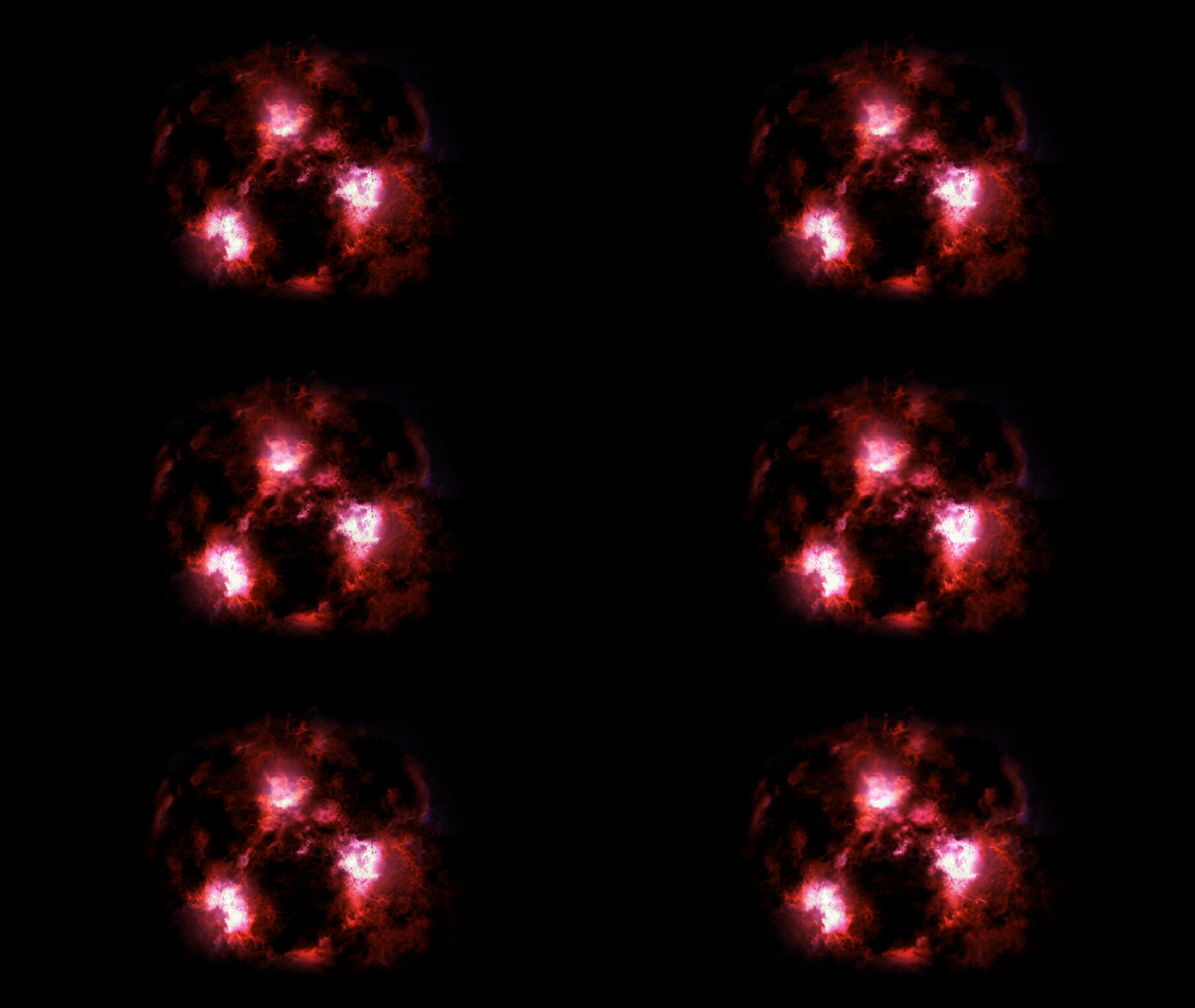
The Fireworks galaxy is known for its supernovas (seen in blue), but a mysterious X-ray explosion (green) has scientists scratching their heads.
What makes that blotch special ? For starters , it ’s not a supernova . TheX - electron beam signaturedetected byNASA ’s Nuclear Spectroscopic Telescope Array ( NuSTAR ) lookout is far more energetic than that of a distinctive supernova . ( you’re able to see one of those plosion glow blue in the upper right corner of the same image . ) But more importantly , the energetic disco biscuit - ray attack also appear and disappeared from the coltsfoot in about 10 days — a much briefer appearance than a supernova , which can brighten and fadeover hundreds of days .
So , the greenish blast of invisible energy is probably not a supernova . What is it , then ? A subject print Aug. 9 inThe Astrophysical Journalprovides a few guesswork . The study authors , who glimpse the mysterious blast of vigour by chance while study supernovas in the Fireworks Galax urceolata , said the mystery explosion in all probability involves one of the most knock-down object in the universe , possibly ablack holeor neutron star , tearing aside one of its prima neighbour .
Related:9 Ideas About Black Holes That Will Blow Your Mind

While black gob are , uh , black , their outer edgesglow with intense radiationwhen nearby objects get rive into the ignominious cakehole ’s orbit . It ’s possible , according to a statementaccompanying the report , that the source of the unripe blast is a opprobrious hole that devoured a nearby star . As the hole ’s overwhelming gravity tide rip that star to shreds , stellar rubble could start spinning around the black hole . detritus closest to the hole’sevent horizon(see : point of no takings ) could revolve so chop-chop that it set out century of multiplication hotter than Earth ’s sun , radiating X - rays as it gets wet-nurse into oblivion .
Aneutron star , the ultradense stiff of a once - mighty star , could also be the perpetrator here . pack just about the same mass asour suninto a globe the size of a city , neutron stars exert a gravitational clout billions of fourth dimension stronger than Earth ’s . However , these star corpses spin so blazingly fast that it can be impossible for nearby debris to reach the object ’s surface , for the same reason that " jump[ing ] onto a carousel that ’s spinning at thou of miles per hour " would be a challenge , lead sketch generator Hannah Earnshaw , a postdoctoral researcher at California Institute of Technology in Pasadena , said in the financial statement .
Sometimes , however , a wobble in a neutron star’smagnetic fieldcan slow the object ’s gyration enough for junk to get pulled into the star ’s glowing anchor ring of demolition , a lineament exchangeable to what might whirl around a black fix . The pull in of detritus like this could result in the sudden appearance and disappearance of an X - ray blast , like what was seen here .

If that ’s the instance , another flash of radiation sickness is probable to appear in the same spot again , observe some future magnetised field wobble . scientist will continue monitoring the Fireworks galaxy for potential repetition performances of this unusual ecstasy - light beam event , waiting for another ill-starred star to go out with a blast .
Originally bring out onLive Science .